

Updated November 2026. This educational guide explains realistic opportunities and risks. No earnings are guaranteed.
Canva can help people produce visual assets, but earning money requires design judgment and paying customers. This guide explores eight legitimate services and the licensing and quality issues beginners should understand.
Canva design is only one route into online work. Compare it with other beginner options in our AI side hustle ideas guide before investing in tools.
How to make money with Canva in 2026: a practical starting point
To explore how to make money with Canva in 2026, pick a service that solves a communication problem: for example, a coordinated presentation deck or six readable social graphics for a small business. Strong offers include a brief, original visual decisions, export sizes and a handoff guide.

What Clients Actually Buy From a Canva Designer
People researching how to make money with Canva should compare practical deliverables, learning time, permissions, and customer demand. The ideas below are examples to evaluate, not claims that every option is profitable. Tool subscriptions, marketplace fees, and regional availability can change.
8 Canva Freelance Services You Can Offer
1. Social media graphics
Social media graphics can be a useful offer when a clearly identified customer needs the outcome. Before selling it, write down the customer’s starting problem, the finished files or service you will deliver, the information you need, and the criteria for acceptance. For a beginner, one focused example is more convincing than a vague promise to do everything with artificial intelligence.
The best starting point is a specific customer problem, not a tool subscription. Ask who needs the result, how they currently solve the problem, what mistakes cost them time, and what a good finished deliverable looks like. Use AI for brainstorming, first drafts, or repetitive steps, but check the work independently before offering it to anyone.
A practical trial is to prepare one original sample of social media graphics using fictional or permission-cleared materials. Time each step, inspect errors, and ask a knowledgeable person to critique the result. If the work cannot be verified or delivered reliably, practice further before accepting a paid project.
2. Presentation redesigns
Presentation redesigns can be a useful offer when a clearly identified customer needs the outcome. Before selling it, write down the customer’s starting problem, the finished files or service you will deliver, the information you need, and the criteria for acceptance. For a beginner, one focused example is more convincing than a vague promise to do everything with artificial intelligence.
Build a sample using information, images, and data you own or have permission to use. Make the sample realistic: include the original brief, your completed work, and a short explanation of quality checks. Never present a fictional portfolio example as a paid customer success story. This small distinction can help build trust.
A practical trial is to prepare one original sample of presentation redesigns using fictional or permission-cleared materials. Time each step, inspect errors, and ask a knowledgeable person to critique the result. If the work cannot be verified or delivered reliably, practice further before accepting a paid project.
3. YouTube thumbnail design
YouTube thumbnail design can be a useful offer when a clearly identified customer needs the outcome. Before selling it, write down the customer’s starting problem, the finished files or service you will deliver, the information you need, and the criteria for acceptance. For a beginner, one focused example is more convincing than a vague promise to do everything with artificial intelligence.
Thumbnail design is part of a much bigger publishing process. Read our faceless YouTube channel guide to understand how thumbnails fit with scripts, licensing and viewer expectations.
To find buyers, focus on a defined audience rather than sending generic messages to thousands of strangers. Study a prospective customer’s public materials, identify one relevant improvement, and offer a tightly scoped pilot. Agree on a deliverable, deadline, revisions, ownership, and payment method in writing before starting.
A practical trial is to prepare one original sample of youtube thumbnail design using fictional or permission-cleared materials. Time each step, inspect errors, and ask a knowledgeable person to critique the result. If the work cannot be verified or delivered reliably, practice further before accepting a paid project.
4. Restaurant menus
Restaurant menus can be a useful offer when a clearly identified customer needs the outcome. Before selling it, write down the customer’s starting problem, the finished files or service you will deliver, the information you need, and the criteria for acceptance. For a beginner, one focused example is more convincing than a vague promise to do everything with artificial intelligence.
Pricing must cover the entire project, including research, editing, communication, revisions, platform charges, and taxes where applicable. A hypothetical $120 project that takes six hours produces $20 per hour before costs; if outreach takes three more hours, it falls to about $13.33 gross per hour. These are examples, not verified market rates.
A practical trial is to prepare one original sample of restaurant menus using fictional or permission-cleared materials. Time each step, inspect errors, and ask a knowledgeable person to critique the result. If the work cannot be verified or delivered reliably, practice further before accepting a paid project.
5. Digital planners
Digital planners can be a useful offer when a clearly identified customer needs the outcome. Before selling it, write down the customer’s starting problem, the finished files or service you will deliver, the information you need, and the criteria for acceptance. For a beginner, one focused example is more convincing than a vague promise to do everything with artificial intelligence.
If you plan to sell a planner more than once instead of doing custom client work, our AI passive income reality check explains the ongoing support and marketing involved.
Watch for privacy, copyright, and accuracy risks. Do not upload confidential client data into an unapproved AI service, reproduce protected assets without rights, fabricate testimonials, or promise guaranteed income. Check current terms of any platform you plan to use. The most useful advantage is dependable judgment, not the ability to generate a large volume of unreviewed material.
A practical trial is to prepare one original sample of digital planners using fictional or permission-cleared materials. Time each step, inspect errors, and ask a knowledgeable person to critique the result. If the work cannot be verified or delivered reliably, practice further before accepting a paid project.
6. Event flyers
Event flyers can be a useful offer when a clearly identified customer needs the outcome. Before selling it, write down the customer’s starting problem, the finished files or service you will deliver, the information you need, and the criteria for acceptance. For a beginner, one focused example is more convincing than a vague promise to do everything with artificial intelligence.
The best starting point is a specific customer problem, not a tool subscription. Ask who needs the result, how they currently solve the problem, what mistakes cost them time, and what a good finished deliverable looks like. Use AI for brainstorming, first drafts, or repetitive steps, but check the work independently before offering it to anyone.
A practical trial is to prepare one original sample of event flyers using fictional or permission-cleared materials. Time each step, inspect errors, and ask a knowledgeable person to critique the result. If the work cannot be verified or delivered reliably, practice further before accepting a paid project.
7. Brand kits
Brand kits can be a useful offer when a clearly identified customer needs the outcome. Before selling it, write down the customer’s starting problem, the finished files or service you will deliver, the information you need, and the criteria for acceptance. For a beginner, one focused example is more convincing than a vague promise to do everything with artificial intelligence.
Build a sample using information, images, and data you own or have permission to use. Make the sample realistic: include the original brief, your completed work, and a short explanation of quality checks. Never present a fictional portfolio example as a paid customer success story. This small distinction can help build trust.
A practical trial is to prepare one original sample of brand kits using fictional or permission-cleared materials. Time each step, inspect errors, and ask a knowledgeable person to critique the result. If the work cannot be verified or delivered reliably, practice further before accepting a paid project.
8. Editable marketing templates
Editable marketing templates can be a useful offer when a clearly identified customer needs the outcome. Before selling it, write down the customer’s starting problem, the finished files or service you will deliver, the information you need, and the criteria for acceptance. For a beginner, one focused example is more convincing than a vague promise to do everything with artificial intelligence.
To find buyers, focus on a defined audience rather than sending generic messages to thousands of strangers. Study a prospective customer’s public materials, identify one relevant improvement, and offer a tightly scoped pilot. Agree on a deliverable, deadline, revisions, ownership, and payment method in writing before starting.
A practical trial is to prepare one original sample of editable marketing templates using fictional or permission-cleared materials. Time each step, inspect errors, and ask a knowledgeable person to critique the result. If the work cannot be verified or delivered reliably, practice further before accepting a paid project.
A 30-day beginner action plan
Week 1: research and learn
Choose one customer group, read its public needs, study relevant tools and platform terms, and create a first sample. Keep a log of actual time and spending.
Week 2: build a portfolio
Create two additional original examples. Explain the brief, your process, what you verified, and what the client would receive. Label fictional projects clearly.
Week 3: find appropriate customers
Contact a limited number of relevant businesses respectfully with a specific offer. Avoid spam, bought lists, unrealistic claims, and pay-to-work schemes.
Week 4: test a paid pilot
Agree on scope, deadlines, fees, privacy, revisions, and ownership. Deliver carefully, ask for feedback, and calculate your real hourly return before expanding.
Tools, expenses, and pricing
Use tools only after you know what task they must accomplish. Compare free plans and paid plans directly on official vendor sites; feature limits, commercial-use rights, taxes, and geographic access can change. Your startup costs may include a device, internet, software, payment fees, marketing, and training time. Do not assume an advertised subscription price represents the full cost of delivering a service.
For illustration, if a project earns $150 but consumes eight hours of production and four hours of outreach, gross revenue per hour is $12.50 before expenses. If revisions add another three hours, it becomes $10. This is not an income forecast. Keep a simple spreadsheet of all time and spending, and revise your pricing based on evidence.
Avoid scams and misleading AI claims
The US FTC’s 2026 side-hustle scam guidance warns against promises of high pay for little effort and requests to pay upfront to obtain work. Verify who is hiring, what the work is, and how payment happens. Never send cryptocurrency to unlock supposed commissions or give unknown recruiters access to sensitive accounts.
If you create content for search engines, follow Google’s people-first content guidance. Focus on original examples, accuracy, usefulness, and transparent limitations instead of producing hundreds of repetitive AI pages.
Sample Canva Project: Delivering a Five-Post Social Media Kit
Imagine a local café needs five original social graphics for a new seasonal menu. Before opening Canva, request the approved logo, brand colours, menu names, prices, and any photography the café owns or is allowed to use. Agree on the target platform, image dimensions, number of concepts, maximum revision rounds and deadline. This turns a vague instruction such as ‘make our social media look better’ into an achievable deliverable.
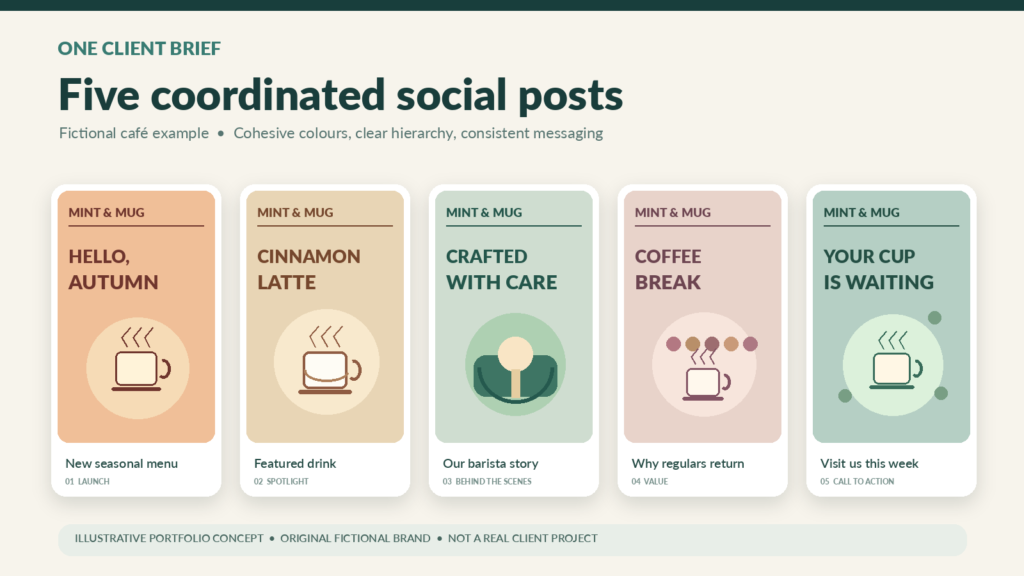
Create a consistent visual system with a readable heading style, high-contrast colours and room for the main message. Plan a purposeful mix of designs: a menu announcement, a product highlight, an opening-hours reminder, a customer-question graphic and a clear offer that has been approved by the business. Do not invent testimonials, discounts or health claims. Check the layouts on mobile screens, not only on a large desktop monitor.
Package the work with files in the sizes the client requested, sensible file names, a note identifying which text can be edited, and a simple publishing order. If the agreement includes editable Canva templates, explain what account or permissions the client needs. Make sure any third-party photographs, fonts and graphics permit the intended use. A paid Canva subscription does not automatically give a client unrestricted rights to redistribute every library asset.
Finally, walk the client through one design and ask them to make a minor text change themselves. If they cannot reliably edit the file, the handoff is incomplete. Keep the project in your portfolio only with the customer’s permission; otherwise, recreate an equivalent fictional example. This workflow can also become a repeatable service package for restaurants, salons or small local retailers without promising sales results.
Frequently asked questions
Can beginners start without buying expensive AI tools?
Often you can practice with existing equipment and limited free plans. The real costs include learning time, reliable internet, and finding customers. Verify current usage rights.
Is this guaranteed to make money?
No. Customer demand, skill, location, competition, and the quality of your work all affect outcomes. Some beginners earn nothing while learning.
How do I find my first client or customer?
Start with a specific problem and a small portfolio. Contact relevant businesses through appropriate channels or explore legitimate marketplaces after checking their fees and terms.
What should I check before using AI for client work?
Confirm confidentiality, permissions, accuracy, intellectual property rights, and whether the client expects disclosure. Keep a human review step.
Is this passive income?
Most services are active work. Digital products may scale, but still need promotion, updates, support, and customer acquisition.
Final takeaway
For how to make money with Canva, success starts with a customer need and a reliable result. Choose one option, produce honest examples, test demand, and improve from real feedback. Explore related articles in Side Hustles, Freelancing, and AI Tools & Income.
Editorial disclosure: Prepared with AI assistance using general public guidance. Examples and prices are illustrative, not verified personal results or individualized financial advice.
A realistic mini-project for canva freelance design
Before spending on premium subscriptions, complete this small practical exercise. It demonstrates useful skills without inventing a client success story or claiming guaranteed earnings.
- Choose one customer profile and assemble a fictional brief with audience, message and brand colors.
- Create a before-and-after sample that demonstrates hierarchy, contrast, spacing and accessible text.
- Clarify whether the client receives editable files, a template link, or exports, and agree on revision limits.
Important limitation: Canva permits many commercial uses but has special restrictions for reselling templates and Pro content. Never resell unaltered Canva library elements as your own standalone products.
Another way to monetize original designs is to sell printed merchandise rather than client services. Our Printify vs. Printful comparison explains the fulfillment economics and margin trade-offs. Check licensing for merchandise before using design assets.
Related guides and official resources
Continue with Digital products, Freelance skill selection, AI-assisted video editing. For current policies or terms, read Canva commercial products and template guidance directly. Rules and prices may change; verify them before selling a service or product.



Pingback: How to Make Money With ChatGPT in 2026: 9 Practical Freelance Services - Money Mantra Hub
Pingback: 10 Freelance Skills in Demand in 2026: A Beginner’s Guide - Money Mantra Hub
Pingback: Is AI Passive Income Real in 2026? 7 Ideas and Risks - Money Mantra Hub
Pingback: How to Start a Virtual Assistant Side Hustle With AI in 2026 - Money Mantra Hub
Pingback: How to Sell Digital Products Online in 2026: Beginner’s Guide - Money Mantra Hub
Pingback: How to Start a Faceless YouTube Channel in 2026 - Money Mantra Hub
Pingback: AI Video Editing Side Hustle in 2026: A Beginner’s Guide - Money Mantra Hub
Pingback: 15 Best AI Side Hustles in 2026: Tools, Costs & Skills
Pingback: Pinterest Affiliate Marketing Without a Website: Step-by-Step Guide (2027) - Money Mantra Hub
Pingback: Pinterest Affiliate Marketing Without a Website (2027 Guide)