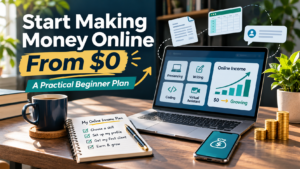

If you’re wondering how to make money online with no money, here is the 30-day roadmap I would follow. I would skip paid surveys, dropshipping ad spend, crypto speculation and expensive courses. Instead, I would focus on one useful digital skill, free AI tools, honest samples and direct conversations with potential customers.
Starting from $0 assumes you already have a computer or phone and internet access. Your time, data, transaction fees and applicable taxes still count. This is a hypothetical action plan, not a claim of personal earnings or a promise of results.
Compare 3 of the Best $0 Startup Models
| Model | Free Tools Needed | Time to First Dollar | Realistic Month-1 Potential |
|---|---|---|---|
| AI freelancing | Claude or ChatGPT, Google Docs or Sheets | Days to weeks if a client buys; possibly longer | $0–$500 illustrative scenario: up to 10 jobs at $50 |
| Canva design services | Canva Free, Google Drive | Days to weeks if a client buys; possibly longer | $0–$300 illustrative scenario: up to 10 jobs at $30 |
| Faceless content | Canva Free, free video editor, social platforms | Weeks to months or longer | $0 is possible throughout month one; prioritize building an audience |
These are planning scenarios, not market averages or predicted earnings. Free tools have usage limits and licensing conditions. There is no guarantee of a sale in 30 days; all amounts are gross, before fees and taxes.
Why Most “Make Money Online With No Money” Advice Fails
Most beginner advice assumes you already have traffic, advertising money or an audience. A digital product or faceless channel can become valuable, but it often takes time to attract buyers. A small service is generally easier to test because you can speak directly to someone who has a problem you can solve.
- Avoid paying for courses before validating demand.
- Do not offer ten unrelated services or promise unlimited revisions.
- Never pay an upfront fee to unlock a job or earnings. See the FTC’s side-hustle scam warning.
- Measure time, expenses and money actually kept, not just gross revenue.
Phase 1 (Days 1–3): Pick One $0-Cost High-Income Skill
Choose a skill with room to grow, not a guaranteed high income. Sell a specific outcome that a client can understand. Start with a small project you can deliver reliably within your current abilities.
Path 1: AI freelancing
Offer document cleanup, research summaries, spreadsheet organization or content repurposing using free AI tools and your own quality checks. Explore how to start a virtual assistant side hustle and freelance skills beginners can develop.
Path 2: Canva design services
Create simple social graphics, menus or presentation layouts using Canva Free. Check the license for each element and avoid copying another business’s branding without permission.
Path 3: Faceless content
Create original educational posts or short videos without appearing on camera. Use this path if you can invest time in audience building before earning. Avoid reposting copyrighted clips or relying on automatic monetization.
Read the best AI side hustles for beginners to compare more options. By day 3, choose one service or content niche and write a one-sentence offer.
Phase 2 (Days 4–7): Build a Free Portfolio Without Past Clients
Create three honest sample projects using fictional information or your own material. Use free versions of Claude, ChatGPT and Canva where appropriate. Label samples as practice projects, not past client work.
- Sample 1: Use Claude to draft five social captions from an original article, then edit them yourself.
- Sample 2: Use ChatGPT to plan a fictional spreadsheet cleanup or administrative workflow, then build a before-and-after example in Google Sheets.
- Sample 3: Use Canva Free to design three matching social graphics for a fictional business.
If you choose a different service, adapt all three samples to the same offer so the portfolio demonstrates consistent skill. Use these best Claude prompts for freelancers to structure the work. Share a view-only portfolio document containing the problem, what you changed and the deliverable.
Set a clear starter offer
| Example offer | Scope | Illustrative price |
|---|---|---|
| Spreadsheet tidy-up | One sheet, up to 100 rows, one revision | $25 |
| Five caption drafts | One approved source | $30 |
| Document formatting | Up to five pages, one revision | $35 |
These prices are examples, not verified market rates. Estimate delivery time, fees and client requirements before quoting.
Phase 3 (Days 8–21): Get Your First Paying Client With $0 Ad Spend
Days 8–14: Find relevant prospects
- Start with your network and identify 15 businesses or creators with a genuine need for your service.
- Send three to five personalized messages per working day where permitted. Never scrape private contact information or send mass spam.
- Publish a useful portfolio example on LinkedIn, Instagram or Pinterest. On Pinterest, create an original pin that links to your portfolio or relevant guide. Use accurate titles and follow platform rules.
- Participate helpfully in relevant communities and promote only where allowed.
For design-focused offers, see how to make money with Canva. Freelance marketplaces may offer free accounts, but bidding and transaction fees can apply; check the Upwork pricing page and Fiverr earnings guidance before signing up.
Example outreach message: Hi [NAME], I noticed [SPECIFIC PUBLIC DETAIL]. I help [TYPE OF BUSINESS] turn one article into a short email draft and five social captions. Here is a sample using my own material: [PORTFOLIO LINK]. Would a small one-off package be useful for your team? No pressure if not.
Days 15–21: Follow up and deliver professionally
Follow up once where appropriate. Refine your offer using the questions prospects ask. If a client accepts, agree on scope, deadline, price, revision limit and payment terms in writing before starting. Request only authorized information, verify every AI-assisted output and follow client disclosure requirements.
Track messages, replies, proposals, paid orders and delivery time. If nobody responds, revise the offer or audience rather than increasing spam. Read our practical guide to AI-assisted freelance services for more ideas.
What a first $500 target could look like
Ten $50 projects would equal $500 in gross sales; four $25 projects would equal $100. These are hypothetical examples, not earnings forecasts. Subtract fees and taxes where applicable, and include prospecting and delivery time when evaluating whether the service is worth repeating. A first month with no sales is also possible.
Phase 4 (Days 22–30): Turn Service Income Into Digital Products
If clients repeatedly need the same checklist, spreadsheet or workflow, consider turning your own original material into a reusable template. If you have not made a sale yet, keep testing the service instead of building a large product around unproven demand.
- Days 22–24: Identify a repeated problem and ask potential buyers what would help.
- Days 25–27: Create a small template with clear instructions, using only material you own or have permission to reuse.
- Days 28–30: Publish a product listing on Gumroad if appropriate, disclose what is included and share it through organic content. Check applicable platform fees and business requirements.
Read how to sell digital products online for a practical launch process. Remember that digital products still require marketing, support and maintenance.
Optional next step: Want a structured resource to plan your online business? Explore Money Mantra Hub’s Digital Business Launch Bundle on Gumroad. This is a paid, optional resource; you can follow the $0 roadmap without purchasing it.
Once your service income provides a cash buffer, you could also consider physical merchandise. Read our Printify vs. Printful profit margin guide before committing: print on demand avoids upfront inventory, but samples and fulfillment before payouts still require money.
Frequently Asked Questions About Making Money Online With $0
Can you really make money online for free?
Yes, it is possible to test a service without new cash spending if you already have equipment and internet access. Your time still has value, fees may apply and a paying customer is not guaranteed.
What is the fastest way to make money online with $0?
A small service based on an existing skill can be quicker to test than a content channel because you can approach prospective clients directly. There is no universal timeline for the first sale.
What are legit ways to make money online without investment?
Document formatting, virtual assistant tasks, original content repurposing and simple design services can be tested with free tools. Avoid offers requiring upfront payments to access jobs or earnings.
How do I start making money online from zero without experience?
Pick a low-risk skill, practice on three fictional projects, create a clearly defined offer and approach relevant prospects respectfully. Never invent qualifications, reviews or results.
If I were starting today, I would pick one small problem, make one honest sample and write one clear offer. The objective of the first month is to learn what people will pay for, not to chase an income screenshot.
Your turn: Which service could you offer with the skills you already have? Share your idea in the comments.
Educational information only. This is not personalized financial, legal, tax or career advice. Fees, platform rules and local business requirements vary. No earnings or outcomes are guaranteed.

Pingback: How to Sell Notion Templates: From Zero to Your First Sale
Pingback: Printify vs. Printful: Which Print-on-Demand Platform Has Higher Profit Margins? - Money Mantra Hub