

Ever looked at your balance a few days after payday and thought, Wait, what happened to all that money? Rent, groceries, transport—a few little extras—and suddenly the month feels expensive. The frustrating part is that it is not always reckless spending. Sometimes you just need a clearer plan.
I prefer to explain budgeting this way: your money has three jobs. It needs to keep life running, give you room to enjoy it, and help future-you breathe a little easier. The 50/30/20 rule organizes those jobs without asking you to give up every coffee, birthday meal or weekend outing.
Let’s work through the numbers together—especially the part most tidy budget graphics leave out: what to do when your actual bills refuse to fit the percentages.
What Is the 50/30/20 Budget Rule?
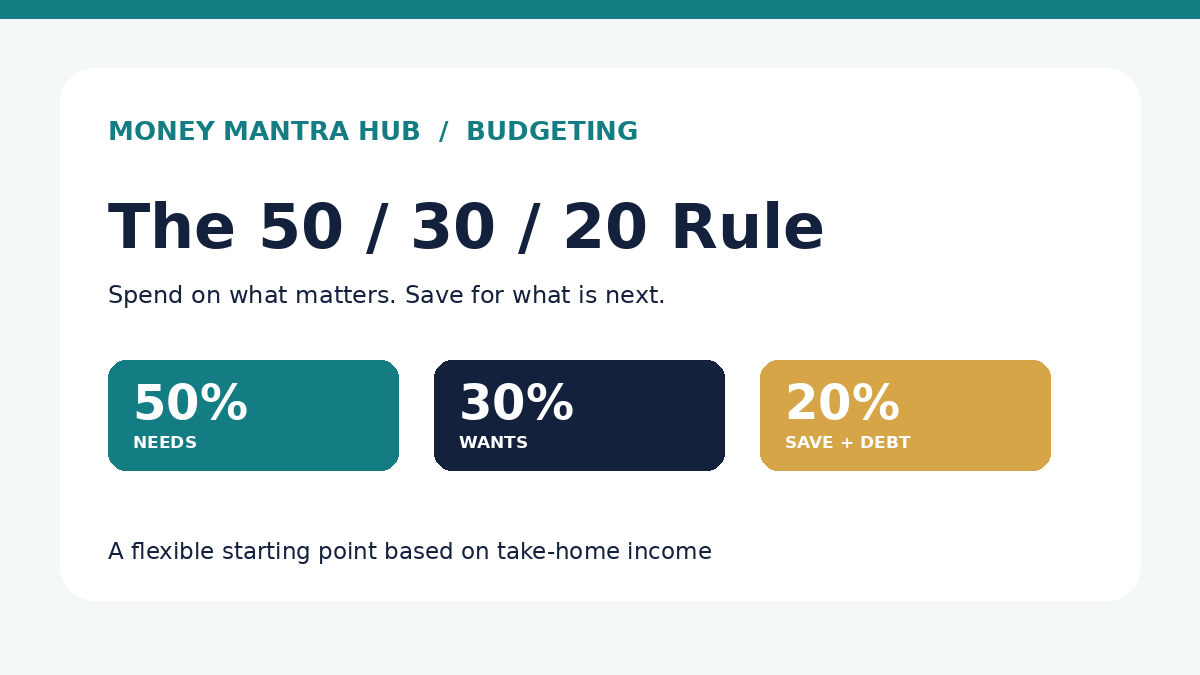
The 50/30/20 budgeting rule divides monthly after-tax income into three broad categories:
- 50% for needs: housing, essential groceries, utilities, insurance, necessary transportation and minimum required debt payments.
- 30% for wants: dining out, streaming services, hobbies, nonessential shopping and other lifestyle choices.
- 20% for savings and extra debt repayment: emergency savings, longer-term goals and payments above the required minimum on debts.
Use take-home income—the money available after taxes and mandatory deductions—not your gross salary. The Consumer Financial Protection Bureau presents this as a common guideline, not a formula every household must follow.
A 50/30/20 Budget Example With $4,000 Take-Home Pay
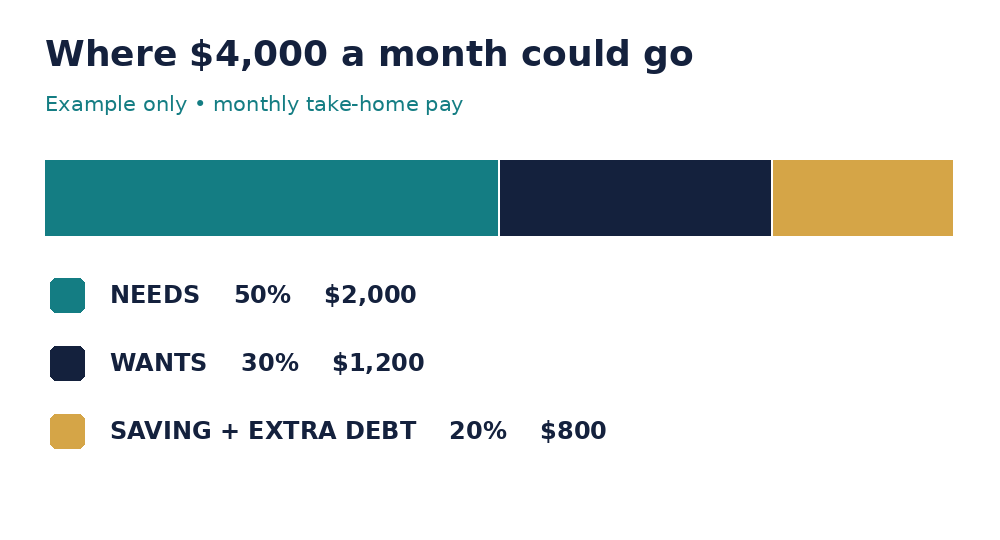
Suppose your household brings home $4,000 per month. Your starting targets would be:
| Budget category | Share | Monthly amount |
|---|---|---|
| Needs | 50% | $2,000 |
| Wants | 30% | $1,200 |
| Savings and extra debt payments | 20% | $800 |
Multiply take-home income by 0.50, 0.30 and 0.20. The wants amount is permission to spend up to that amount—not a target you need to hit. If you spend only $900 on wants, you could put the other $300 toward an emergency fund or debt repayment.
But if your essential bills already cost $2,300, pretending the $2,000 target is realistic will not lower your rent. Make a workable adjustment instead.
Needs vs. Wants: Where Do Your Expenses Belong?
Needs: The Costs That Keep Life Running
Needs include basic housing, groceries, essential healthcare, utilities, transport to work, required childcare, insurance and contractual minimum debt payments. A basic phone plan may also be essential for employment or safety.
The important word is essential. Groceries are a need; regular gourmet delivery usually is not. Travel to work is a need; a luxury car upgrade is a choice. When possible, separate the necessary portion of a bill from optional upgrades.
Wants: Enjoyment Without the Guilt
Wants cover restaurant meals, movies, optional subscriptions, concerts, hobbies and vacations. These are not automatically irresponsible purchases. Enjoyment is one reason we earn money, and leaving room for it makes a spending plan easier to maintain.
Choose two or three favorites you genuinely value. Keep your weekly dinner with friends, perhaps, while cancelling subscriptions you rarely use. Good budgeting means prioritizing memorable spending over forgettable spending.
Savings and Debt: Paying Your Future Self
This category can support an emergency cushion, planned major expenses, retirement saving or additional payments on debt. Put required debt minimums under needs so you do not count them twice. If retirement or insurance is deducted from payroll, account for those deductions consistently when defining available take-home pay.
If high-interest debt is a major burden, you may want to allocate more than 20% to repayment once essential bills are covered. If money is very tight, starting with a smaller savings amount may be more realistic.
How to Start a 50/30/20 Budget in Six Steps
1. Calculate Your Actual Monthly Income
Check pay statements and bank deposits. If paid twice monthly, add both deposits. If paid every two weeks, multiply one typical deposit by 26 and divide by 12 for a monthly average; also check the actual dates bills fall due. Freelancers and hourly workers should use a conservative estimate, not assume their highest-earning month will repeat.
2. Review Your Last 30 Days of Spending
Read your bank and card transactions. Group the expenses into needs, wants and savings or extra repayment. Include irregular bills: a $600 annual insurance premium is a $50 monthly planning expense. This review is about useful facts, not guilt.
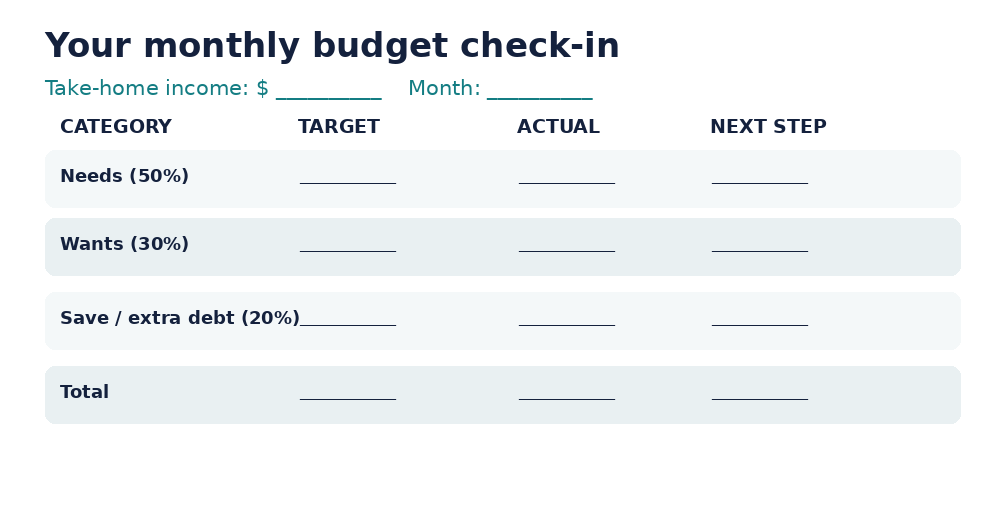
3. Write Down Your Three Starting Targets
Multiply monthly take-home pay by 50%, 30% and 20%. Put the amounts in a notebook, spreadsheet or monthly expense tracker. You do not need an expensive budgeting app to begin.
4. Check Whether Essential Bills Fit
Add rent, basic food, utilities, transportation, health costs, childcare, insurance and minimum debt payments. If the total exceeds 50%, identify the largest drivers. Small subscription cuts can help, but housing and transport often have a bigger impact. Some changes take time; plan around your real bills until then.
5. Protect the Things You Love
Choose the experiences you most want to keep and deliberately give them room. Reduce lower-value purchases first. For occasional larger treats, put aside a modest amount each payday instead of relying on a surprise credit-card bill.
6. Automate Carefully and Review Monthly
If your cash flow allows, schedule a transfer to a separate emergency savings account after payday—without risking overdrafts or missed bills. Check spending for five minutes each week, then compare targets with actual results at month-end. Adjust after changes to income, rent or family circumstances.
What If the 50/30/20 Rule Doesn’t Fit?
Imagine taking home $2,500 while unavoidable essentials total $1,650. Your needs already use 66% of income. Forcing a 50% ceiling would be unhelpful.
One temporary plan might be $1,650 for needs, $475 for wants and $375 for saving or extra debt repayment—approximately a 66/19/15 split. The amounts add up to $2,500. If this still exceeds your capacity, begin with essential bills and a realistic smaller savings goal when possible.
Here is the part worth remembering: your first priority is paying essentials and avoiding new high-cost debt, not satisfying an infographic. The CFPB’s spending-rule worksheet explicitly encourages choosing guidance that suits your circumstances.
Five Common 50/30/20 Budgeting Mistakes
- Budgeting with gross income: taxes and payroll deductions reduce spendable money.
- Ignoring annual bills: renewals, repairs and gifts still need monthly provisions.
- Calling every purchase essential: distinguish basic services from optional upgrades.
- Counting debt payments twice: required minimums are needs; extra repayment goes under the 20% category.
- Treating percentages as a moral score: the rule is a tool, not a verdict on your circumstances.
Frequently Asked Questions
Is the 50/30/20 rule good for beginners?
Yes, it can simplify personal finance basics by using three main categories instead of dozens of spending limits. Review actual transactions and adjust the starting proportions where necessary.
Does rent have to stay below 50% of income?
The 50% category covers all essentials, not rent alone. If housing consumes a large portion, be realistic about what remains for food, transportation and medical needs.
Can I use this rule with credit card debt?
Yes. Keep required minimum payments in needs, and allocate additional repayment from the savings and debt portion. Your debt costs and emergency reserve needs may justify different percentages.
Do I need a budgeting app?
No. Paper or a basic spreadsheet works. The best tracker is one you actually update. The Federal Trade Commission’s budgeting guide explains a simple process, and its free budget worksheet can help.
Your First 15-Minute Money Reset
Before you close this page, write down last month’s take-home income, your five biggest essential expenses and one want you would like to keep. Calculate your three starting amounts. If the numbers do not fit, change the ratios and write one achievable adjustment for next month.
No one gets extra credit for having a mathematically beautiful budget that falls apart by Friday. A useful budget is one you can live with, revisit, and improve. What is one expense you love keeping—and one you would happily cut? Share your answer in the comments or send this guide to someone who wants a simpler monthly budget. For more practical ideas, explore our Saving Money guides.
MONEY MANTRA HUB • PRACTICAL BUDGETING WORKBOOK
Ready to Build Your Own 50/30/20 Budget?
You’ve learned how the 50/30/20 rule works. Now turn the percentages into a real spending plan without giving up everything you enjoy. The 50/30/20 Budgeting Workbook: Keep What You Love & Build a Money Plan takes you beyond the article with guided exercises and reusable budget worksheets.
- Updated 47-page PDF edition with practical exercises and worksheets
- Set targets for needs, wants, savings and extra debt payments using your actual take-home income
- Work through needs-versus-wants decisions, monthly spending and changing income
- Plan for emergencies, irregular expenses and ongoing budget check-ins
Get the complete workbook for $3.99 USD. One-time purchase, digital PDF download. The 50/30/20 percentages are a flexible starting point—not a requirement or a promise of savings.
Secure checkout and digital delivery through Gumroad. Educational resource only; not personalized financial advice.
Educational note: This article provides general financial education, not personalized financial, tax or investment advice. The calculations are hypothetical and should be adapted to individual circumstances.
Further reading and editorial information
meet the Money Mantra Hub author · read our sourcing and corrections policy.