
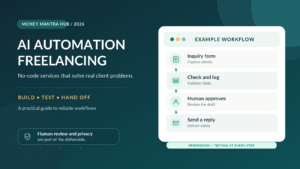

Updated November 2026. This educational guide explains realistic opportunities and risks. No earnings are guaranteed.
AI automation freelancing is about connecting business processes safely and reliably. Visual workflow builders can reduce coding requirements, but testing, permissions, error handling, and client communication remain essential.
To see how workflow setup compares with other beginner service businesses, explore our AI side hustle comparison before choosing a niche.
AI automation freelancing in 2026: a practical starting point
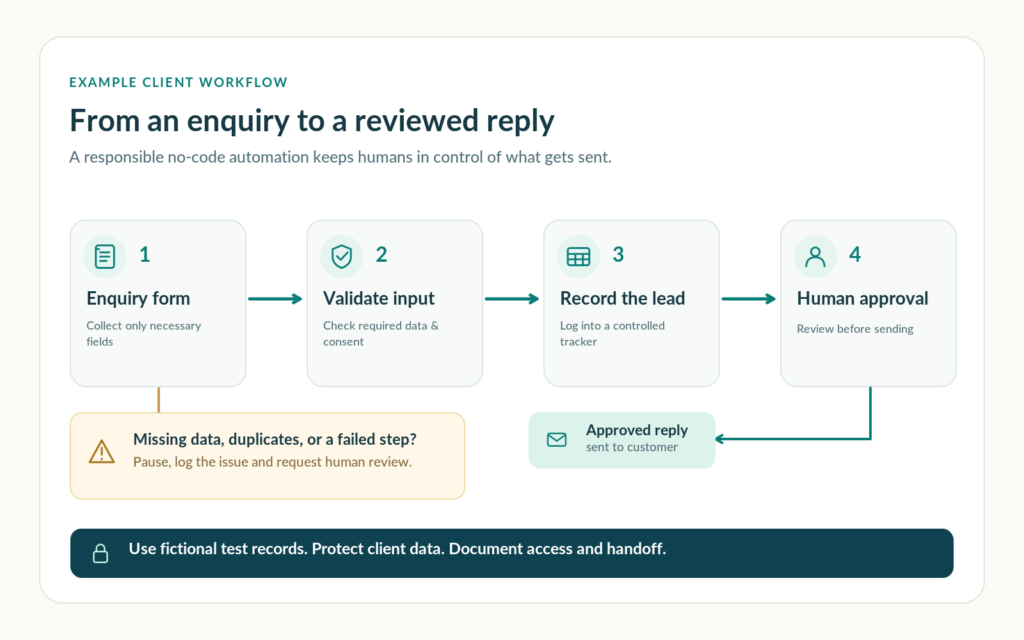
AI automation freelancing in 2026 is most practical when it eliminates an identifiable manual step. For a first sample, build a workflow that receives a fictional enquiry form, records the submission in a spreadsheet and alerts a designated human reviewer. Prove it handles missing information and duplicate submissions.
What Clients Pay for in No-Code Automation
People researching AI automation freelancing should compare practical deliverables, learning time, permissions, and customer demand. The ideas below are examples to evaluate, not claims that every option is profitable. Tool subscriptions, marketplace fees, and regional availability can change.
9 No-Code AI Automation Services to Explore
1. Form-to-spreadsheet workflows
Form-to-spreadsheet workflows can be a useful offer when a clearly identified customer needs the outcome. Before selling it, write down the customer’s starting problem, the finished files or service you will deliver, the information you need, and the criteria for acceptance. For a beginner, one focused example is more convincing than a vague promise to do everything with artificial intelligence.
The best starting point is a specific customer problem, not a tool subscription. Ask who needs the result, how they currently solve the problem, what mistakes cost them time, and what a good finished deliverable looks like. Use AI for brainstorming, first drafts, or repetitive steps, but check the work independently before offering it to anyone.
A practical trial is to prepare one original sample of form-to-spreadsheet workflows using fictional or permission-cleared materials. Time each step, inspect errors, and ask a knowledgeable person to critique the result. If the work cannot be verified or delivered reliably, practice further before accepting a paid project.
2. Lead response automation
Lead response automation can be a useful offer when a clearly identified customer needs the outcome. Before selling it, write down the customer’s starting problem, the finished files or service you will deliver, the information you need, and the criteria for acceptance. For a beginner, one focused example is more convincing than a vague promise to do everything with artificial intelligence.
Build a sample using information, images, and data you own or have permission to use. Make the sample realistic: include the original brief, your completed work, and a short explanation of quality checks. Never present a fictional portfolio example as a paid customer success story. This small distinction can help build trust.
A practical trial is to prepare one original sample of lead response automation using fictional or permission-cleared materials. Time each step, inspect errors, and ask a knowledgeable person to critique the result. If the work cannot be verified or delivered reliably, practice further before accepting a paid project.
3. Appointment reminders
Appointment reminders can be a useful offer when a clearly identified customer needs the outcome. Before selling it, write down the customer’s starting problem, the finished files or service you will deliver, the information you need, and the criteria for acceptance. For a beginner, one focused example is more convincing than a vague promise to do everything with artificial intelligence.
Calendar coordination is also a common administrative task. Our AI-assisted virtual assistant guide explains which parts should stay under human supervision.
To find buyers, focus on a defined audience rather than sending generic messages to thousands of strangers. Study a prospective customer’s public materials, identify one relevant improvement, and offer a tightly scoped pilot. Agree on a deliverable, deadline, revisions, ownership, and payment method in writing before starting.
A practical trial is to prepare one original sample of appointment reminders using fictional or permission-cleared materials. Time each step, inspect errors, and ask a knowledgeable person to critique the result. If the work cannot be verified or delivered reliably, practice further before accepting a paid project.
4. Support ticket classification
Support ticket classification can be a useful offer when a clearly identified customer needs the outcome. Before selling it, write down the customer’s starting problem, the finished files or service you will deliver, the information you need, and the criteria for acceptance. For a beginner, one focused example is more convincing than a vague promise to do everything with artificial intelligence.
Pricing must cover the entire project, including research, editing, communication, revisions, platform charges, and taxes where applicable. A hypothetical $120 project that takes six hours produces $20 per hour before costs; if outreach takes three more hours, it falls to about $13.33 gross per hour. These are examples, not verified market rates.
A practical trial is to prepare one original sample of support ticket classification using fictional or permission-cleared materials. Time each step, inspect errors, and ask a knowledgeable person to critique the result. If the work cannot be verified or delivered reliably, practice further before accepting a paid project.
5. Invoice status alerts
Invoice status alerts can be a useful offer when a clearly identified customer needs the outcome. Before selling it, write down the customer’s starting problem, the finished files or service you will deliver, the information you need, and the criteria for acceptance. For a beginner, one focused example is more convincing than a vague promise to do everything with artificial intelligence.
Watch for privacy, copyright, and accuracy risks. Do not upload confidential client data into an unapproved AI service, reproduce protected assets without rights, fabricate testimonials, or promise guaranteed income. Check current terms of any platform you plan to use. The most useful advantage is dependable judgment, not the ability to generate a large volume of unreviewed material.
A practical trial is to prepare one original sample of invoice status alerts using fictional or permission-cleared materials. Time each step, inspect errors, and ask a knowledgeable person to critique the result. If the work cannot be verified or delivered reliably, practice further before accepting a paid project.
6. Content approval workflows
Content approval workflows can be a useful offer when a clearly identified customer needs the outcome. Before selling it, write down the customer’s starting problem, the finished files or service you will deliver, the information you need, and the criteria for acceptance. For a beginner, one focused example is more convincing than a vague promise to do everything with artificial intelligence.
For a concrete creative-work example, see our Canva design services guide, where final file checks and client approval matter.
The best starting point is a specific customer problem, not a tool subscription. Ask who needs the result, how they currently solve the problem, what mistakes cost them time, and what a good finished deliverable looks like. Use AI for brainstorming, first drafts, or repetitive steps, but check the work independently before offering it to anyone.
A practical trial is to prepare one original sample of content approval workflows using fictional or permission-cleared materials. Time each step, inspect errors, and ask a knowledgeable person to critique the result. If the work cannot be verified or delivered reliably, practice further before accepting a paid project.
7. Inventory notification systems
Inventory notification systems can be a useful offer when a clearly identified customer needs the outcome. Before selling it, write down the customer’s starting problem, the finished files or service you will deliver, the information you need, and the criteria for acceptance. For a beginner, one focused example is more convincing than a vague promise to do everything with artificial intelligence.
Build a sample using information, images, and data you own or have permission to use. Make the sample realistic: include the original brief, your completed work, and a short explanation of quality checks. Never present a fictional portfolio example as a paid customer success story. This small distinction can help build trust.
A practical trial is to prepare one original sample of inventory notification systems using fictional or permission-cleared materials. Time each step, inspect errors, and ask a knowledgeable person to critique the result. If the work cannot be verified or delivered reliably, practice further before accepting a paid project.
8. Reporting summaries
Reporting summaries can be a useful offer when a clearly identified customer needs the outcome. Before selling it, write down the customer’s starting problem, the finished files or service you will deliver, the information you need, and the criteria for acceptance. For a beginner, one focused example is more convincing than a vague promise to do everything with artificial intelligence.
To find buyers, focus on a defined audience rather than sending generic messages to thousands of strangers. Study a prospective customer’s public materials, identify one relevant improvement, and offer a tightly scoped pilot. Agree on a deliverable, deadline, revisions, ownership, and payment method in writing before starting.
A practical trial is to prepare one original sample of reporting summaries using fictional or permission-cleared materials. Time each step, inspect errors, and ask a knowledgeable person to critique the result. If the work cannot be verified or delivered reliably, practice further before accepting a paid project.
9. Human-in-the-loop AI agents
Human-in-the-loop AI agents can be a useful offer when a clearly identified customer needs the outcome. Before selling it, write down the customer’s starting problem, the finished files or service you will deliver, the information you need, and the criteria for acceptance. For a beginner, one focused example is more convincing than a vague promise to do everything with artificial intelligence.
Pricing must cover the entire project, including research, editing, communication, revisions, platform charges, and taxes where applicable. A hypothetical $120 project that takes six hours produces $20 per hour before costs; if outreach takes three more hours, it falls to about $13.33 gross per hour. These are examples, not verified market rates.
A practical trial is to prepare one original sample of human-in-the-loop ai agents using fictional or permission-cleared materials. Time each step, inspect errors, and ask a knowledgeable person to critique the result. If the work cannot be verified or delivered reliably, practice further before accepting a paid project.
A 30-day beginner action plan
Week 1: research and learn
Choose one customer group, read its public needs, study relevant tools and platform terms, and create a first sample. Keep a log of actual time and spending.
Week 2: build a portfolio
Create two additional original examples. Explain the brief, your process, what you verified, and what the client would receive. Label fictional projects clearly.
Week 3: find appropriate customers
Contact a limited number of relevant businesses respectfully with a specific offer. Avoid spam, bought lists, unrealistic claims, and pay-to-work schemes.
Week 4: test a paid pilot
Agree on scope, deadlines, fees, privacy, revisions, and ownership. Deliver carefully, ask for feedback, and calculate your real hourly return before expanding.
Tools, expenses, and pricing
Use tools only after you know what task they must accomplish. Compare free plans and paid plans directly on official vendor sites; feature limits, commercial-use rights, taxes, and geographic access can change. Your startup costs may include a device, internet, software, payment fees, marketing, and training time. Do not assume an advertised subscription price represents the full cost of delivering a service.
For illustration, if a project earns $150 but consumes eight hours of production and four hours of outreach, gross revenue per hour is $12.50 before expenses. If revisions add another three hours, it becomes $10. This is not an income forecast. Keep a simple spreadsheet of all time and spending, and revise your pricing based on evidence.
Avoid scams and misleading AI claims
The US FTC’s 2026 side-hustle scam guidance warns against promises of high pay for little effort and requests to pay upfront to obtain work. Verify who is hiring, what the work is, and how payment happens. Never send cryptocurrency to unlock supposed commissions or give unknown recruiters access to sensitive accounts.
If you create content for search engines, follow Google’s people-first content guidance. Focus on original examples, accuracy, usefulness, and transparent limitations instead of producing hundreds of repetitive AI pages.
How to Test an Automation Before Client Handoff
An automation that works once in a demo may still fail in everyday use. Create fictional test records before connecting a real client’s systems. Test a valid entry, a duplicate entry, an empty field, an incorrect email address and a situation where the receiving application is temporarily unavailable. For each test, write down the expected outcome and the actual outcome. This small exercise reveals problems that polished screenshots often hide.
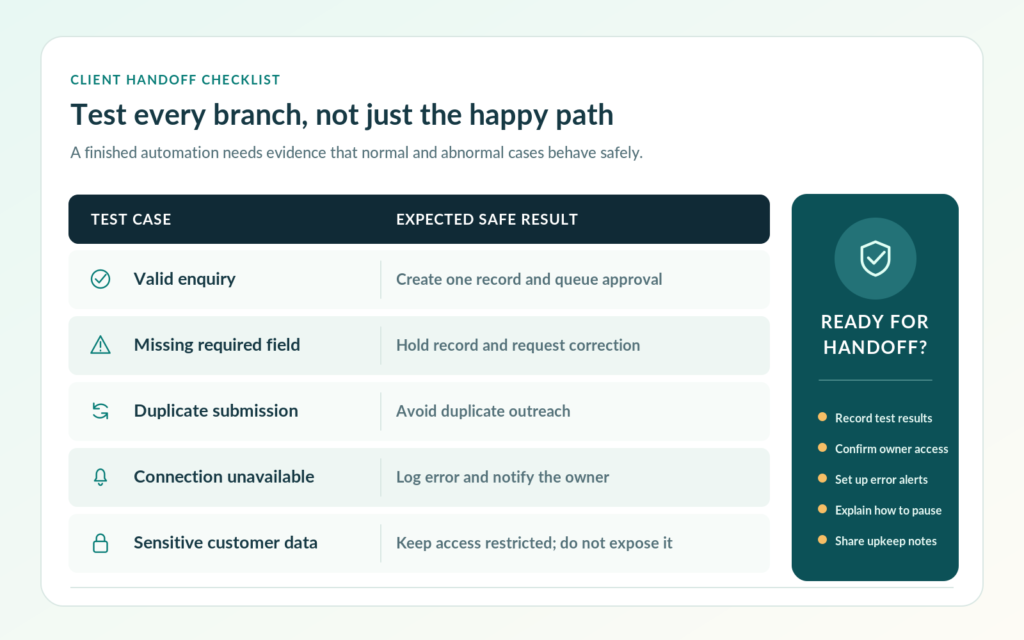
Agree on a human approval step for messages, refunds, payments, personal information and other sensitive actions. A lead-response flow, for example, might prepare a draft that a staff member approves rather than automatically emailing every form submission. Make sure the client knows where incoming records are stored, who can access them, how errors are reported and how the workflow can be paused.
At handoff, deliver a plain-language diagram, a short screen recording or written walkthrough, a list of connected accounts, and instructions for editing the workflow safely. Include who pays for recurring software subscriptions and what happens when an API token expires or a platform changes its limits. A useful maintenance agreement specifies what is monitored, how often checks happen and which fixes require a separate quote.
Keep a change log during the pilot. If a step is added to reduce missed leads, measure the number of messages sent, the number of errors and any time saved using the client’s agreed baseline. Avoid reporting a percentage improvement without underlying measurements. Reliable small automations build a stronger portfolio than complex unattended agents with unclear safeguards.
Frequently asked questions
Can beginners start without buying expensive AI tools?
Often you can practice with existing equipment and limited free plans. The real costs include learning time, reliable internet, and finding customers. Verify current usage rights.
Is this guaranteed to make money?
No. Customer demand, skill, location, competition, and the quality of your work all affect outcomes. Some beginners earn nothing while learning.
How do I find my first client or customer?
Start with a specific problem and a small portfolio. Contact relevant businesses through appropriate channels or explore legitimate marketplaces after checking their fees and terms.
What should I check before using AI for client work?
Confirm confidentiality, permissions, accuracy, intellectual property rights, and whether the client expects disclosure. Keep a human review step.
Is this passive income?
Most services are active work. Digital products may scale, but still need promotion, updates, support, and customer acquisition.
Final takeaway
For AI automation freelancing, success starts with a customer need and a reliable result. Choose one option, produce honest examples, test demand, and improve from real feedback. Explore related articles in Side Hustles, Freelancing, and AI Tools & Income.
Editorial disclosure: Prepared with AI assistance using general public guidance. Examples and prices are illustrative, not verified personal results or individualized financial advice.
A realistic mini-project for no-code ai automation
Before spending on premium subscriptions, complete this small practical exercise. It demonstrates useful skills without inventing a client success story or claiming guaranteed earnings.
- Map the business process first: trigger, allowed data, actions, owner and exception path.
- Test with made-up customer records, then record successful runs and the failure cases.
- Deliver an editable workflow map, account-owner handoff notes, and a simple fallback if the automation stops.
Important limitation: Avoid automated outreach without consent. A workflow that saves minutes but sends incorrect messages or leaks customer details is not a successful result.
Related guides and official resources
Continue with ChatGPT freelance services, Freelance skill selection, Virtual assistant workflow. For current policies or terms, read FTC job scam prevention directly. Rules and prices may change; verify them before selling a service or product.



Pingback: How to Make Money With ChatGPT in 2026: 9 Practical Freelance Services - Money Mantra Hub
Pingback: 10 Freelance Skills in Demand in 2026: A Beginner’s Guide - Money Mantra Hub
Pingback: 15 Best AI Side Hustles in 2026: Tools, Costs & Skills
Pingback: How to Start a Virtual Assistant Side Hustle With AI in 2026 - Money Mantra Hub